Across residential real estate, the same conversation is playing out again and again. Teams are under pressure. Voids feel stubbornly high. Leasing is slow and manual. Residents expect more. Investors want clarity. And somewhere along the way, the conclusion often becomes: “We need a new PMS.”

But here’s the uncomfortable truth: for most institutional owners and operators, the PMS is not the problem. The real issue is that the PMS was never designed to run modern rental operations.
Let’s be clear. Legacy PMS platforms are very good at what they were built for:
And they should remain the system of record for those functions.
What they were not designed to do is orchestrate the lived reality of renting today:
Over time, operators have tried to force PMS platforms to do these things anyway. The result is familiar: bolt-on tools, spreadsheets, inboxes, duplicated data, manual workarounds and fragmented teams.
When performance starts to suffer, the instinct is to rip everything out and replace the PMS, but that’s rarely the correct answer.
Replacing a PMS is one of the most disruptive changes an organisation can make.
It means:
And crucially, it often delivers little improvement to day-to-day operations, because the new PMS is still fundamentally an accounting system, not an operational one.
The real question shouldn’t be “Which PMS should we move to?”
It should be: “How do we unlock more value from the PMS we already have?”
This is where the concept of a rental operating system matters.
Residently is not a replacement for your PMS. It sits above it.
Think of it as the connective tissue between:
Your PMS remains the financial backbone. Residently becomes the operational engine.
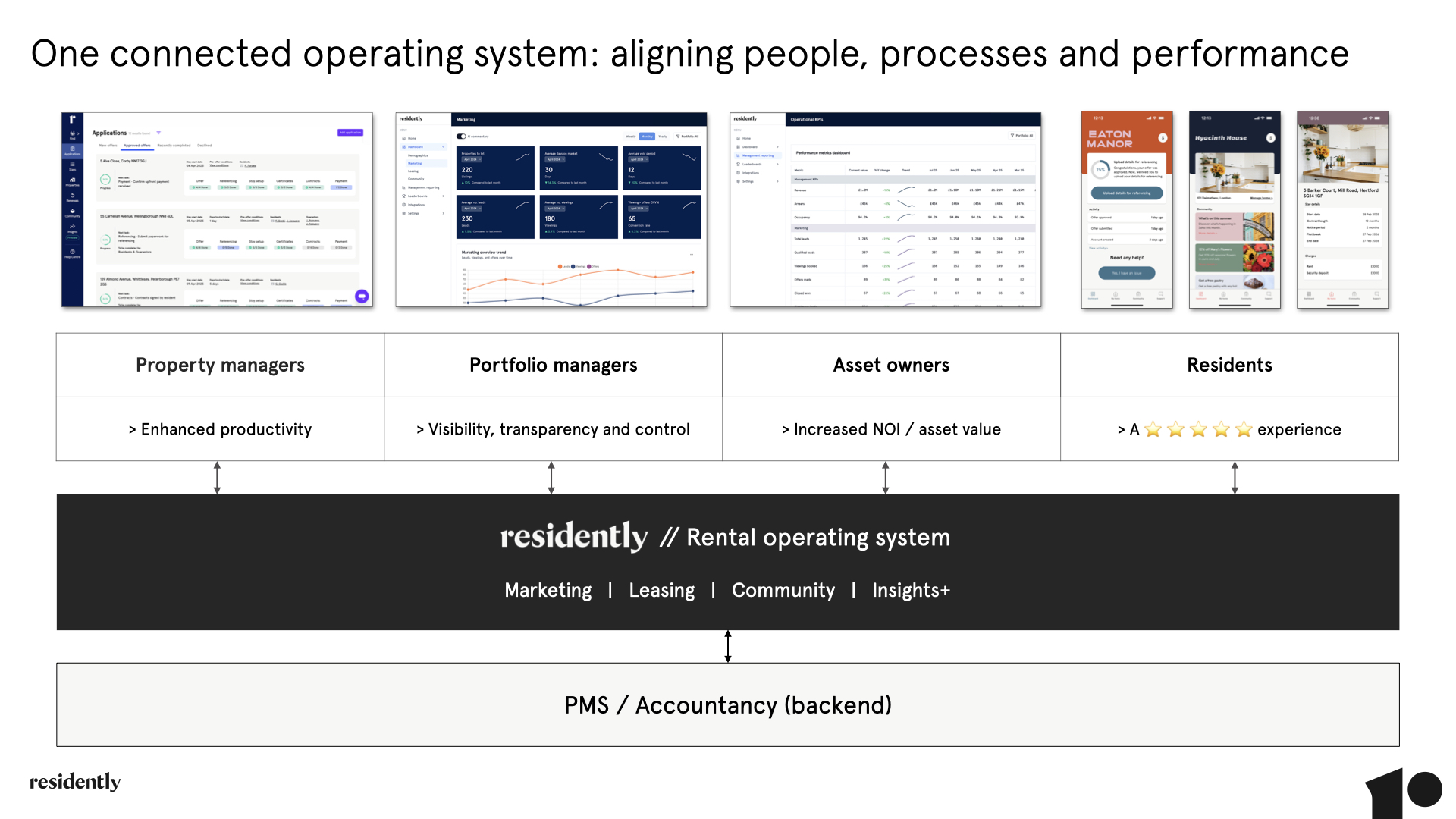
Most PMS platforms are systems of record. They tell you what happened.
Residently is a system of action. It ensures the right things happen faster.
By syncing with your existing PMS in real time, Residently:
No duplicate data entry. No manual reconciliation. No downtime. It is literally as simple as turning a portfolio on.
In a market defined by yield compression and rising costs, performance is no longer driven solely by rent. Operations drive it.
Disconnected systems create delays between marketing, leasing, approvals and move-ins. Residently removes those handoffs, reducing avoidable voids by up to 30%.
By automating over 7 hours of tenancy admin per unit, teams spend less time chasing tasks and more time driving value.
A seamless, mobile-first resident experience from application to renewal improves satisfaction and reduces churn.
Modern renters will pay for clarity, speed and service. Operational excellence becomes a revenue lever, not just a cost control.
Unified, real-time data turns operations into evidence. Auditable, explainable and defensible.
One of the biggest misconceptions we see is that improving operations requires replacing core systems.
It doesn’t.
Residently integrates with existing PMS, CRM and accounting platforms and works alongside them. That means:
For operating teams, the change is immediate but not disruptive.
For institutional owners and operators, operations are no longer a back-office concern. They are a front-line differentiator.
When you can demonstrate:
You don’t just run assets better.
You win mandates.
You raise capital.
You future-proof portfolios.
That is the role of a rental operating system.
So before committing to a costly PMS replacement, it’s worth pausing and asking:
Do we actually need a new PMS – or do we need to get more out of the one we already trust?
In most cases, the answer is clear.
The PMS handles the books. Residently handles the business of renting.
And together, they turn operational performance into a competitive advantage.