Fragmented systems aren’t just inconvenient; they’re expensive. Across the UK living sector, operators are losing revenue, increasing turnover, burning staff capacity, and hitting a ceiling on scalable growth simply because their operations sit across too many disconnected tools.
%20(1)%201.png)
Here’s what fragmentation really costs institutional owners.
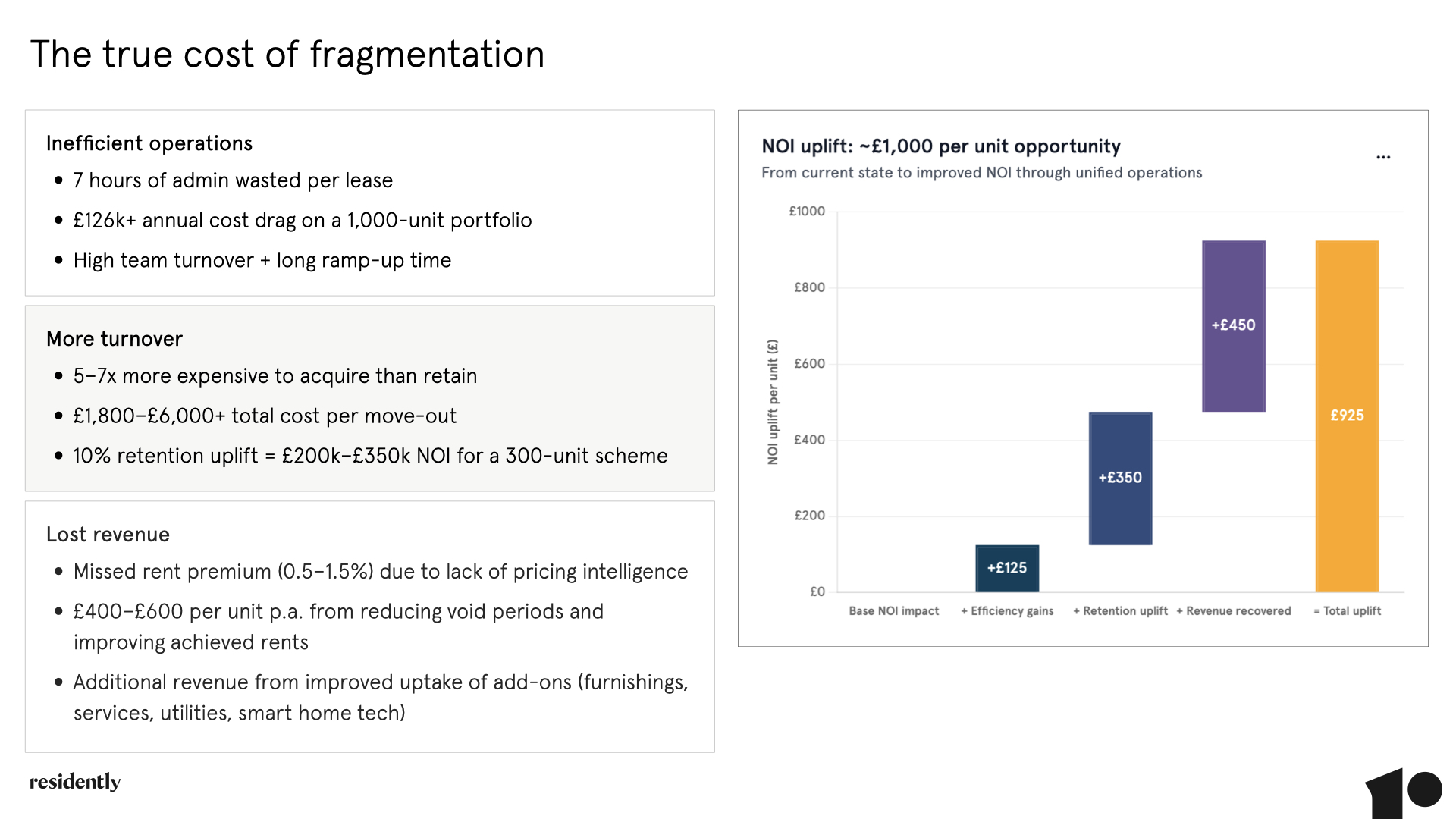
The biggest drag on NOI is operational inconsistency. Fragmentation makes it worse.
When marketing, leasing, pricing and renewals all happen in different systems, operators lose money in four places:
Without integrated data on demand, sentiment and pricing trends, many schemes undercharge relative to their true market position, missing the 0.5–1.5% yield premium that comes from experience-led leasing and dynamic pricing.
Without AI or consolidated demand data:
A fragmented workflow from viewing → application → reference → contract adds friction at every stage. This is how “normal” voids stretch from 3 weeks to 4–6 weeks.
At £1,500–£2,500 per month, that’s £500–£3,750 lost per turnover.
Energy packages, cleaning, parking, furniture rental and amenity add-ons convert poorly when they sit outside the resident journey.
Small percentages compound: Every missed £10–£30 per month per tenancy amounts to £100k–£300k in annual losses on a mid-size portfolio.
It costs 5–7x more to acquire a new resident than to retain an existing one And every turnover triggers a cascade of costs:
3–6 weeks of lost rent
= £1,000–£3,750 per unit per churn
Cleaning, repairs, and repainting
= £500–£1,500
Listings, lead gen, agent fees
= £300–£800 per letting
Add them up:
Each additional move-out costs £1,800–£6,000+ in lost revenue and expenses.
For a 300-unit scheme, improving retention by just 10% adds:
£200,000–£350,000 in annual NOI.
Retention is one of the most powerful value levers in residential real estate. And it’s the most overlooked.
Fragmentation destroys retention because the resident experience feels disjointed: five systems, five logins, inconsistent communication, slow maintenance responses, and no feedback loop.
This might cut it in the old high-street agent way, but not in the institutional world.
Fragmented systems force teams to:
On average:
At £18/hour, that’s:
£126 saved per tenancy
£126,000 per year saved on a 1,000-unit portfolio — just in time cost.
But the hidden cost is bigger:
When teams spend more time administering tenancies than on relationship-building or problem-solving, stress and inefficiency skyrocket.
Recruitment, onboarding and training for property management roles often cost £4,000–£7,000 per hire, with a ramp-up time of 3–6 months.
Fragmentation forces operators into a cycle of:
A unified system reverses this by providing process clarity, automation, and consistent workflows.
The invisible ceiling that stops operators from scaling past a certain size.
This is where fragmentation becomes existential.
When operations are split across five or more systems, adding more units leads to:
Instead of economies of scale, you get diseconomies of scale.
At a certain point, operators hit a limit:
And you just become bigger. Not better.
A unified operating system removes this ceiling by ensuring:
That’s what scalability actually requires—the control and insights to maximise performance.
Fragmentation costs institutional owners through:
Residently eliminates these costs by unifying the entire resident journey into a single operating system that:
Because in the living sector, you don’t grow by adding more tools. You grow by removing the friction between them.