Every PMS vendor now has an agent to sell, but most start at the wrong end. Drawing on Antony Slumbers, Remen Okoruwa, Brad Hargreaves and McKinsey, here is what agents need to stand on to create value rather than risk.

Agentic AI will create value in UK residential only where it runs on a governed operating layer. Bolted onto a legacy stack, it automates the leaks it was meant to close.
Every PMS vendor and point-solution provider now has an agent to sell, and most of them start at the agent. That is the wrong end. What an agent can see, what it can do, and who checks its work determine whether it creates value or risk.
An agent amplifies whatever it sits on. Most operators still run an accounting-first PMS, plus separate tools for listings, leads, viewings, applications, payments, maintenance and community, stitched together with spreadsheets, emails and phone calls.
Different teams. Different systems. That stack already leaks yield and data at every handover. Point an agent at it, and the leaks run faster.
Antony Slumbers, speaking at the ARL AI event, put it bluntly: "Legacy real estate software slows AI down." You cannot bolt AI onto legacy systems and expect magic: "fix the chassis before you buy the engine." Fix the chassis before buying the engine >
He also warns that most AI in real estate is today's work done faster and cheaper. Efficiency every competitor shares "isn't an advantage; it's a cost of staying in the game." The advantage sits in what the agent can see and is allowed to do.
Remen Okoruwa, co-founder and CEO of Propexo, locates the failure precisely: "AI doesn't fail because the models are bad. It fails because the data underneath is fragmented, siloed, and stuck behind inaccessible APIs."
The research points the same way. Gartner expects over 40% of agentic AI projects to be cancelled by the end of 2027, noting that integrating agents into legacy systems "can be technically complex, often disrupting workflows and requiring costly modifications."
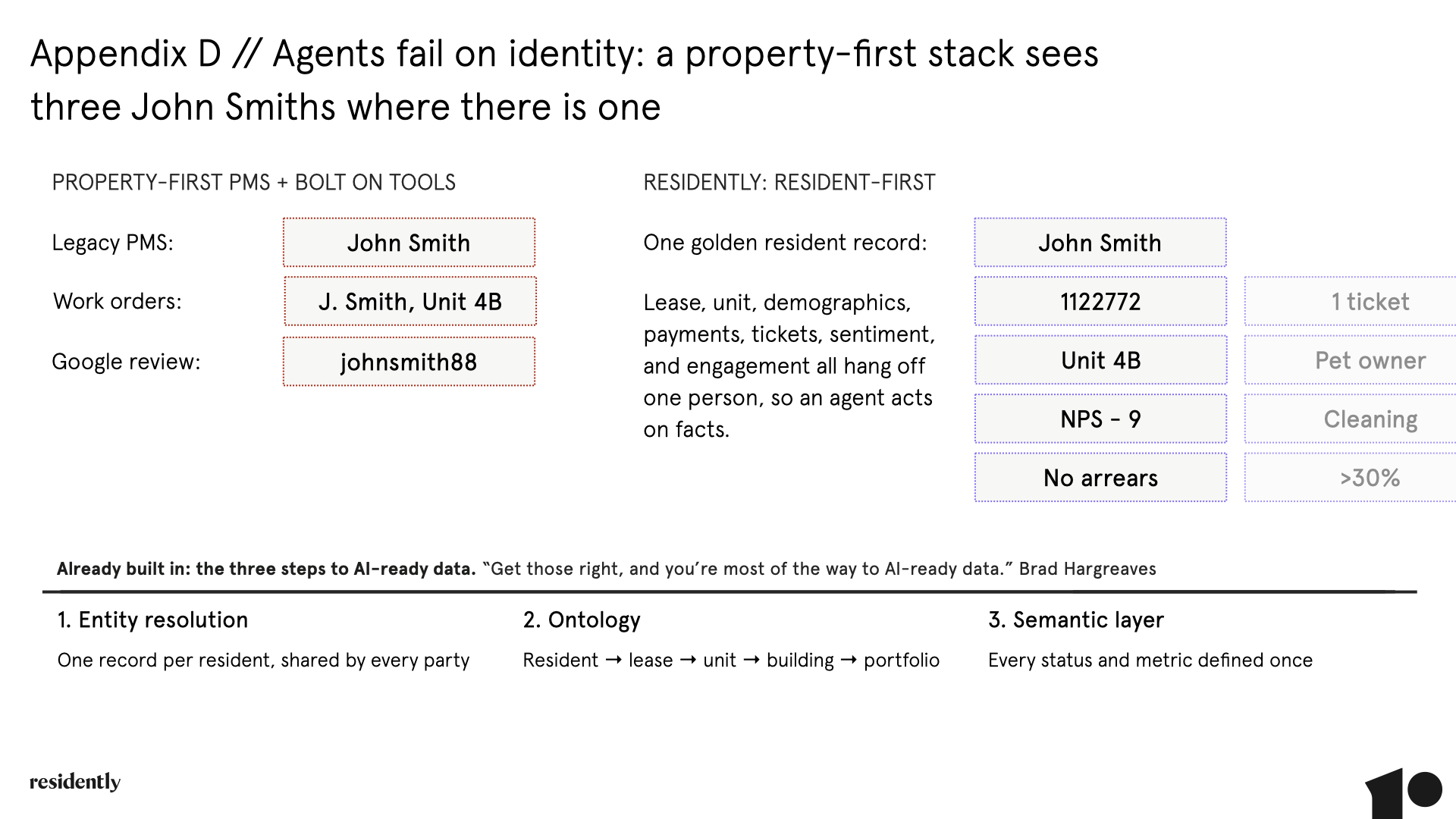
The first thing an agent needs to know is who it is dealing with. Brad Hargreaves, founder of Thesis Driven, frames the problem: "Three John Smiths are living in your multifamily building, and it just derailed your AI implementation."
In a property-first stack, the PMS knows John Smith, work orders know J. Smith in Unit 4B, and Google Reviews knows johnsmith88. Nothing links the three. A bolt-on arrears agent chases one, a renewals agent scores another, and a repairs agent answers the third, each confidently wrong.
Remen's verdict on numbers built this way is hard to improve on: "Every count built across those systems is a guess wearing the costume of a fact." An agent acting on a guess is a compliance risk with a fast reaction time.
Brad Hargreaves names three steps to AI-ready data, adding: "Get those right, and you're most of the way to AI-ready data." Our rental operating system has all three built in:
Residently plugs into the existing PMS and accounting backend, two-way and in real time. As Remen observes, "The real source of truth is no longer the PMS." It is the resident-first operating layer above it.
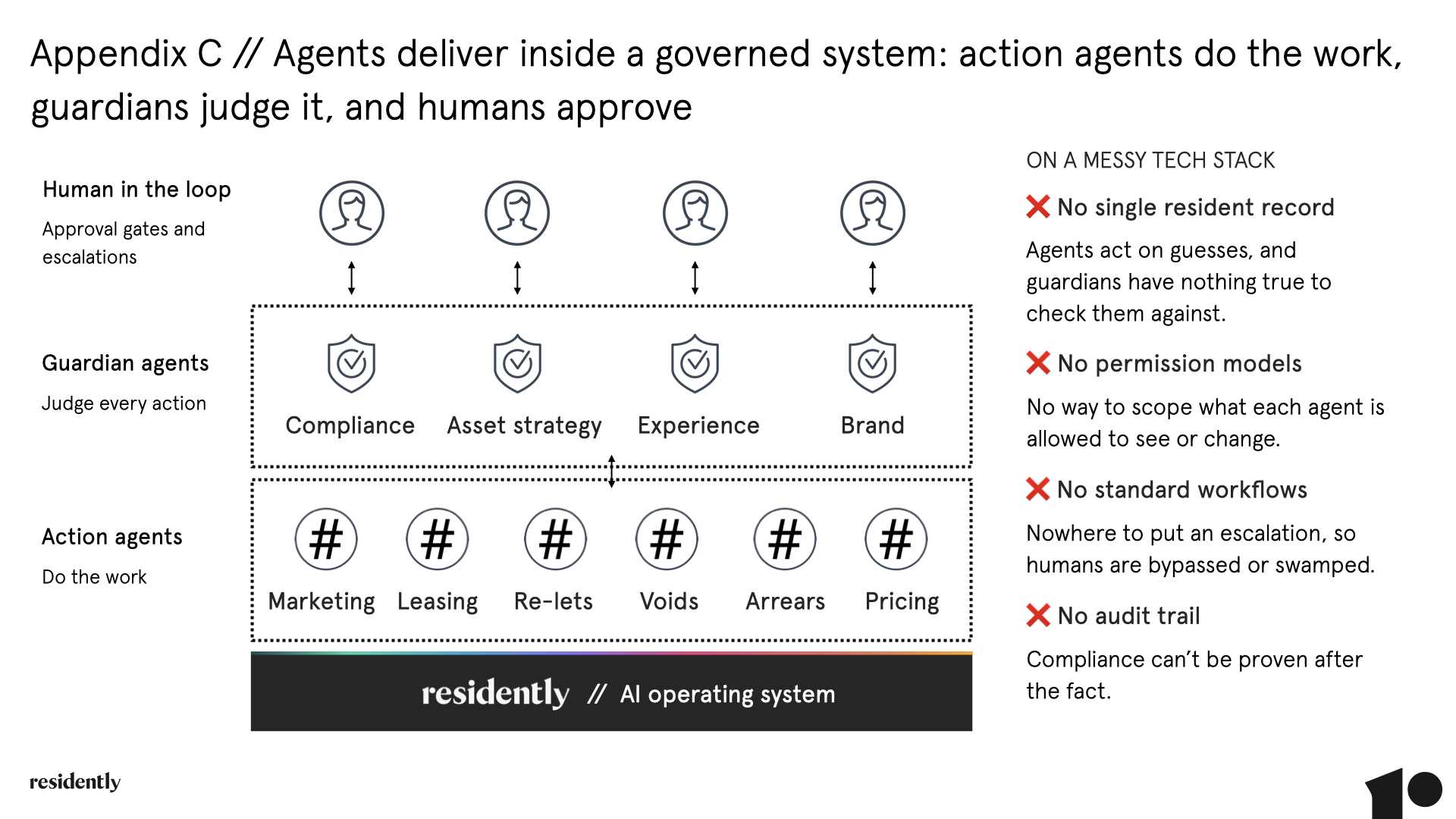
Clean data is necessary but not sufficient. McKinsey sets the bar: "Agentic systems must be designed with controls that match the risk: role-based permissions, human approval where required, audit trails."
In residential, that means three layers, each with a clear job:
Take a Section 13 rent increase. The pricing agent proposes a rent from quality-scored comparables and achieved rents. The compliance guardian checks the form, the notice period and the frequency cap; the asset strategy guardian checks the target; above a set threshold, the asset manager approves. The workflow produces the written evidence pack and audit trail, ready for tribunal.
That sequence depends on four things a patchwork cannot provide. Our rental operating system enables each of them:
This is hub-and-spoke control applied to agents. Asset strategy is set centrally; local teams, third-party agents and AI agents all execute on the same workflows; the data stays with the asset, whoever, or whatever, runs it.
The operators who win with agentic AI will not be the first to buy an agent. They will be the ones whose agents know one John Smith, act within rules set by the asset strategy, and leave an audit trail a valuer can trust.
Others are starting at the agent. We’ve been building what agents have to sit on: a resident-first record, standardised workflows, role-based access, and guardrails aligned to the asset strategy.
Book a walkthrough to see the operating layer your agents will stand on.