How institutional residential portfolios are exposed by fragmented operations — and how a unified operating system changes the calculus.
.png)
For institutional residential operators, risk management is typically framed as a finance function. Stress-test the debt. Model the downside scenario. Hedge the interest rate exposure. These are necessary disciplines, but they address the risks that are already visible, already quantified, already on the balance sheet.
The risks that quietly erode NOI are rarely those in the model. They are the renewal that nobody chased because it fell between two systems. The void that ran four weeks longer than it should have because the pricing decision was based on last month's data. The compliance obligation that was missed not through negligence, but because it lived in a spreadsheet that three people maintained inconsistently. The maintenance backlog that became a resident satisfaction problem that became a retention problem that became an income problem — by the time it appeared in a quarterly report, the damage was already done.
This is the nature of operational risk in residential real estate at scale: it compounds in the gaps. And in portfolios running across multiple schemes, multiple operators, and multiple geographies, there are a great many gaps.
Portfolio managers generally think about residential risk across four categories. What is less often appreciated is how quickly those categories bleed into each other.
Income risk is the most familiar. Voids, arrears, lease-up delays, and pricing misjudgements all threaten the revenue line. At a 4–5% cap rate, the arithmetic is unforgiving: a £50,000 reduction in NOI doesn't register as a P&L problem — it registers as a £1–1.25 million reduction in asset value. Income risk is therefore always, simultaneously, an asset value risk.
Operational risk is where most institutional operators underestimate their exposure. Inconsistent processes across sites, over-reliance on individual team members' institutional knowledge, manual data entry errors, and fragmented tooling all produce unpredictable outcomes. The question is not whether operational inconsistency exists in a multi-site portfolio — it does, almost universally — but whether it is visible and manageable, or hidden and compounding.
Compliance and regulatory risk has grown considerably in complexity. The evolving legislative landscape — from the Renters' Rights Act to EPC obligations, deposit protection requirements, right-to-rent checks, and referencing standards — creates a dense web of obligations that must be met consistently across every tenancy, every time. At portfolio scale, the probability of a breach occurring somewhere is not a remote tail risk. Without systematic controls, it approaches certainty.
Data and visibility risk is perhaps the most underappreciated category of all. If portfolio managers cannot access accurate, real-time performance data across operators and geographies, they cannot intervene early. And if they cannot intervene early, every other risk category becomes more expensive to resolve. Delayed reporting doesn't just inconvenience the management process; it structurally disables risk management by turning it into a risk retrospective.
The critical insight is that these four risks do not stay in their lanes. They cascade. An operational failure creates an income risk: a preventable void. A data failure means that the void goes unnoticed until it has become a pattern across multiple units. A compliance failure triggers reputational exposure that affects leasing velocity and, therefore income. The cascade is not theoretical. It is the lived experience of any portfolio that has grown faster than its operational infrastructure.
The institutional residential sector has, over the past decade, adopted technology enthusiastically — but not always strategically. The typical operator today runs a patchwork of point solutions: one system for listings, another for referencing, a legacy platform for accounting, and a combination of spreadsheets and email for everything in between.
Each individual tool may perform its narrow function adequately. The problem is structural. When data lives in multiple disconnected systems, there is no single moment at which a portfolio manager can see the whole picture. Risk hides in the handoffs — in the gap between the leasing system and the referencing platform, between the maintenance tool and the resident communication record, between what the site team knows and what the asset manager can see.
This creates what might be called the "patchwork problem": the organisation generates enormous amounts of operational data, but that data is never unified into intelligence. Reporting requires manual aggregation, which takes time, introduces error, and produces a picture of the past rather than the present. By the time a rising void rate, a deteriorating resident satisfaction score, or a maintenance backlog appears in a monthly summary, the window for cost-effective intervention has frequently closed.
The cost of this fragmentation is rarely captured on any single line of a P&L. It shows up diffusely in slightly longer voids, in marginally higher agent fees, in the occasional compliance penalty, and in the retention rate that is two or three percentage points lower than it should be. Individually, each item seems manageable. Aggregated across a portfolio and translated into asset value at institutional cap rates, the picture changes considerably.
The foundational response to operational risk at scale is standardisation. Standard operating procedures define what good looks like, not for one site or one manager, but for every site and every manager, consistently and auditably.
The logic is straightforward. If every scheme follows the same process for lease renewals, void marketing, maintenance escalation, and resident onboarding, then performance becomes predictable. Predictable performance can be measured. Measured performance can be improved. This is the basis of institutional-grade operations.
In practice, SOPs address risk across several specific dimensions.
Consistency across geographies eliminates what might be called "operator variance" — the performance differential that emerges when different sites handle the same process differently. A portfolio operating across multiple regions with multiple local operators is inherently exposed to this variance. SOPs define the standard, regardless of who is executing it or where.
Reduced key-person dependency is one of the less-discussed but more significant operational risks in residential property management. When processes live in people's heads, staff turnover is an operational crisis: institutional knowledge walks out the door, and the new hire faces a steep and undocumented learning curve. When processes live in a system, onboarding is faster, standards are maintained, and the organisation's knowledge base is genuinely institutional rather than personal.
Audit trails and accountability are the compliance dimension of standardisation. SOPs embedded in software create a timestamped record of every action: what happened, when it happened, and who actioned it. This is not merely useful for internal management — it is the foundation of defensibility in the event of a regulatory challenge or dispute. In a sector where compliance obligations are increasing in number and scrutiny, this matters.
Escalation and early warning is where SOPs move from process management to risk management. Well-designed procedures include trigger rules: if a maintenance ticket is unresolved beyond a defined threshold, it surfaces automatically. If a renewal has not been initiated within a specified window before lease expiry, it flags for action. The SOP becomes a detection mechanism, not merely a checklist.
The critical caveat is that SOPs only deliver these benefits when they are embedded in the operating system itself — not documented in a policy manual that lives on a shared drive. A procedure that exists outside the workflow is a procedure that will be applied inconsistently. A procedure that is part of the workflow is one that is followed by design.
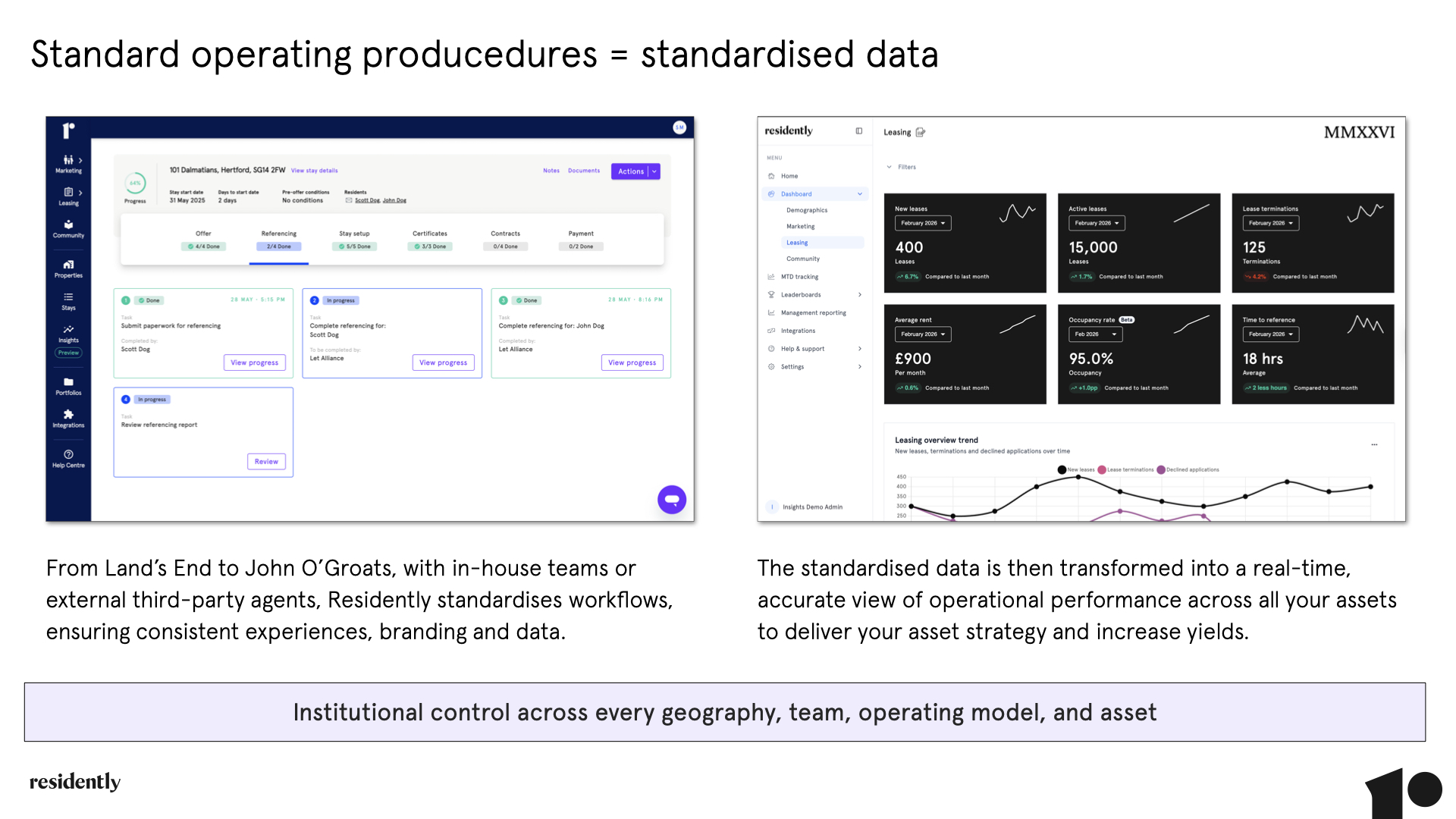
SOPs define how work should happen. Data tells you whether it is happening — and what the outcome is.
This distinction matters because the traditional residential reporting model is retrospective by design. Monthly management accounts, quarterly investor reports, periodic operational reviews: these are valuable, but they are descriptions of what has already occurred. For risk management purposes, what has already occurred is precisely what you no longer have the opportunity to prevent.
Real-time, standardised data changes the management calculus fundamentally. Rather than receiving a report that a void rate has increased, a portfolio manager can see — today, not next month — that time-on-market is trending upward at a specific scheme, that viewing conversion has dropped, that the pricing position has not been adjusted in response to local market movement. These are leading indicators. Acting on leading indicators is categorically different, in both cost and outcome, from responding to lagging ones.
The "standardised" element is as important as the "real-time" one. Data from multiple operators and systems is only comparable when it is structured consistently. Without standardisation, portfolio-wide analysis requires manual normalisation — an exercise that consumes time, introduces interpretation error, and produces results that different stakeholders will read differently. Standardised data means that a void rate at one scheme means exactly the same thing as a void rate at another. It means that portfolio managers can compare performance across geographies with confidence, identify outliers, understand what drives outperformance, and replicate it.
This capability has a dimension that goes beyond internal management. Institutional capital requires institutional reporting. When asset owners and investors receive consistent, transparent, real-time performance data — rather than narrative summaries that smooth over variance — they maintain confidence in the management thesis. That confidence is not a soft outcome. It protects the capital relationship, supports future fundraising, and is itself a form of risk management.
Residently's Rental Operating System was built on a foundational premise: that operational excellence and financial performance are not separate disciplines. The platform unifies the entire tenancy lifecycle — marketing, leasing, resident experience, and portfolio reporting — into one connected system, one source of truth, with real-time visibility for every stakeholder.
The risk management implications of this architecture are direct.
Income risk is addressed through revenue management tools that track time-on-market in real time, enabling pricing decisions based on current market data rather than historical reports. Automated lead qualification and viewing scheduling compress the void period from the moment a unit becomes available. Our clients reduce controllable voids by up to 30% — a figure that, at portfolio scale and institutional cap rates, represents significant and recurring asset value protection.
Operational risk is addressed through standardised workflows embedded in the platform itself. Every process — from the initial listing through referencing, contract execution, resident onboarding, maintenance management, and renewal — follows a defined, auditable path. Automated chasing, escalation triggers, and task management mean that nothing relies on a single individual's memory or initiative. Residently saves operators more than seven hours of admin per tenancy; more importantly, it removes the variability that creates operational exposure.
Compliance risk is addressed through integrated referencing, automated contract generation, and the audit trail that the platform creates as a natural by-product of its workflow. Every action is timestamped and attributable. Right-to-rent checks, deposit protection, and referencing requirements are embedded in the leasing journey rather than managed separately, reducing the probability of a missed obligation to near zero.
Data and visibility risk is addressed through Insights+, our real-time reporting suite designed specifically for portfolio managers and asset managers. Insights+ consolidates operational data across the entire portfolio, translates it into structured, comparable performance metrics, and surfaces it in dashboards that align with fund-level KPIs. The view is not yesterday's data normalised by the finance team — it is a live picture of operational performance that enables genuine proactive management.
The architecture that makes this possible is the unified platform itself. Because marketing, leasing, resident experience, and reporting all operate within a single system, the data is already standardised, already connected, and already meaningful. There is no manual aggregation, no inter-system reconciliation, no gap between what happened and what the portfolio manager can see. Risk does not hide in the handoffs, because the handoffs no longer exist.
The case for operational modernisation is sometimes presented as a technology argument. It is more accurately a financial one.
Consider a portfolio of 1,000 units operating with fragmented tooling and inconsistent processes. If controllable voids run two weeks longer per tenancy cycle than they should — a conservative estimate given the evidence — the income leakage across the portfolio is material. If renewal conversion is three percentage points lower than an optimised process would achieve, the cost of re-letting those additional units, including agent fees of approximately £1,000 per let, accumulates quickly. If one compliance breach per quarter generates a regulatory penalty and the associated management time and reputational cost, the annual exposure is measurable.
None of these numbers are dramatic in isolation. Aggregated and then translated into asset value at a 4–5% cap rate, they represent a gap between the portfolio's actual performance and its potential that belongs on the asset management agenda — not the operations agenda.
The inverse is equally true. Residently clients who bring leasing in-house using the platform save approximately £1,000 per let in agent fees. A 30% reduction in controllable voids, applied across a portfolio with an average void cost, produces a number that goes directly to NOI. A 1% improvement in achievable rent — the premium that a genuinely institutional resident experience supports — compounds across every unit and every tenancy cycle. These are not marginal efficiency gains. At institutional cap rates, they are asset value creation.
Risk cannot be managed without visibility. In residential real estate at scale, the greatest risk management failure is not a bad decision made with good information — it is a decision deferred, or made badly, because the information arrived too late or couldn't be trusted.
The operational risks that quietly compound across a portfolio — the inconsistent process, the missed renewal, the void that ran too long, the compliance obligation that fell through the gap between systems — are not inevitable. They are the predictable consequence of infrastructure that was not designed for institutional-grade management.
A unified rental operating system, with standardised workflows and real-time data at its core, does not merely make operations more efficient. It makes risk visible, manageable, and ultimately preventable. And in a market where every pound of NOI is worth twenty or more in asset value, the ability to see risk before it costs you is not an operational nicety.
It is the competitive advantage.